One of the first questions I ask when interviewing a Property Manager is this:
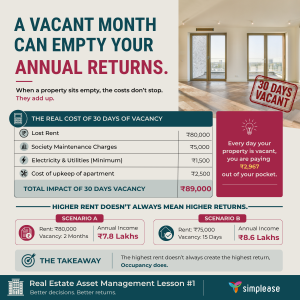
A property owner has two offers on the table.
➡️ Option A: ₹75,000/month rent. Tenant can move in within 15 days.
➡️ Option B: ₹80,000/month rent. Tenant can move in after 2 months.
Which offer should the owner accept?
Most candidates immediately choose Option B.
After all, ₹80,000 is more than ₹75,000.
Higher rent = better outcome.
Right?
Not quite.
Because ₹80,000 × 10 occupied months is less money than ₹75,000 × 11.5 occupied months. In fact, even ₹85,000 is a worse outcome than ₹75,000 in this scenario. And that is without even considering the additional expenses that go with a vacant property.
Because property management is not about maximizing rent.
It’s about maximizing returns.
And those are two very different things.
A vacant property is one of the most misunderstood costs in real estate.
When a property sits empty:
➡️ Rent stops.
➡️ Society charges continue.
➡️ Utility bills continue.
➡️ Upkeep expenses continue.
The meter never stops running.
That’s why when candidates answer this question, I’m not testing arithmetic.
I’m testing whether they understand the difference between price optimization and return optimization.
Where this lesson becomes even more important is during the possession of a new residential project.
I’ve seen projects where 500-600 owners receive possession around the same time and there are suddenly 200 apartments available for rent.
Suddenly, every owner wants a tenant.
And every owner believes their apartment deserves a premium.
The problem?
The tenant now has 200 alternatives.
You are no longer competing against the broader market. You are competing against your own neighbours.
In such situations, many owners make the mistake of holding out for the “right” rent.
Meanwhile the property sits vacant. One month becomes two. Two months becomes four. The irony is that the lost rent during the vacancy often exceeds the additional rent they were trying to negotiate in the first place.
In many cases, the financially smarter decision is to get the rent meter running quickly.
Even if that means accepting a rent that is 20-25% below what you believe is the long-term fair value.
Because once occupancy is established, you have options. Rents can be recalibrated during renewal cycles and gradually brought back in line with prevailing market rates.
What you can never recover is rent from a month that has already passed.
The best landlords understand that a vacant apartment generates 0% of market rent.
A leased apartment generates cash flow.
And in real estate, cash flow usually beats ego.
The objective isn’t to achieve the highest rent.
The objective is to achieve the highest annual income.
Those are not always the same thing.
hashtag#RealEstate hashtag#PropertyManagement hashtag#RentalIncome hashtag#AssetManagement hashtag#LandlordTips hashtag#RealEstateInvesting hashtag#Simplease



About The Author
